

Privacy Policy for Websites in 2026: 7 Live Checks for Multi-Site Portfolios
A useful guide to privacy policy for websites should help readers understand both the rule and the behavior behind the rule. That is where consent topics become genuinely practical instead of sounding like recycled compliance copy.
The practical review for privacy policy for websites starts when you look past the banner copy and test the live behavior. That is usually where teams find the real gaps: tags firing too early, weak refusal flows, and settings that drift after routine site changes.
That is where the current official guidance still points. The California Privacy Protection Agency says the CCPA requires “a Notice at Collection and a privacy policy” and that required notices should be “easy to understand.” The California Attorney General’s current CCPA page still frames required notices as explanations of a business’s privacy practices. The European Commission still says the required information must be presented in a concise, transparent, intelligible form using “clear and plain language.” And the ICO still says you should not restrict privacy information to a single page only and may need “a layered approach” with information delivered where collection actually happens.
If you want the closest companion reads first, start with these guides to privacy policy for website, privacy policy template, and website privacy checker. This page stays narrower. It is the privacy policy for websites review I would use this week for a company running multiple brand sites, subdomains, stores, help centers, or campaign pages.
If your team is trying to get privacy policy for websites under control without adding a heavyweight privacy stack, DataShyre can help. DataShyre focuses on consent and preference management that are easier to implement, easier to operate, and easier to trust on a live site. Start with DataShyre’s consent and preference management or book a demo.
If your team needs the policy set to match the live stack instead of just sounding complete, DataShyre can help with data mapping, consent management, and implementation QA across multi-site portfolios so notices, banners, vendors, and rights paths stay aligned.
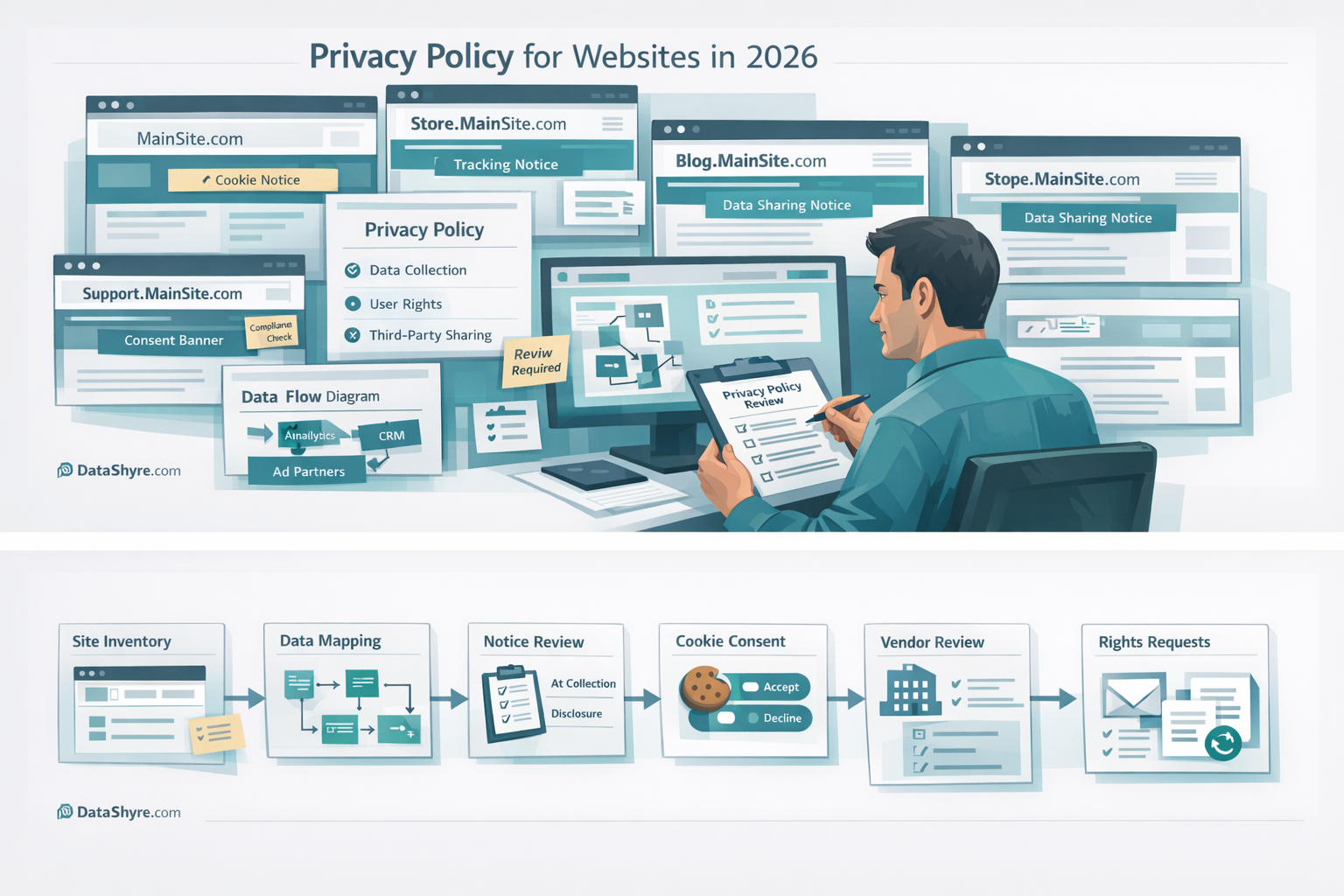
1. Decide whether one policy can honestly cover every site
The first privacy policy for websites mistake is assuming one central page is automatically simpler or safer.
Sometimes one shared policy does work. If the same entity controls the sites, the same categories of personal data are collected, the same vendors are used, the same rights path applies, and the same cookie behavior appears across the portfolio, one well-structured policy can be easier to maintain.
But that is a big if.
If the main marketing site, the ecommerce store, the support center, and the recruitment site all collect different fields, use different processors, or trigger different tracking tools, a single generic page often becomes too vague to help users or internal teams.
So before publishing privacy policy for websites, decide which model fits reality:
- one shared policy with site-specific sections;
- one main policy plus short site-level supplements; or
- separate policies for materially different sites or brands.
My rule of thumb is simple: if separate sites would force you to write materially different answers about collection, sharing, retention, or rights, they probably need separate site-level disclosures even if a parent privacy hub still exists.
2. Map collection points site by site, not only brand by brand
This is where privacy policy for websites work usually breaks.
The ICO’s drafting guidance still says to start by understanding what personal data you have, what you do with it, why you process it, where it came from, who you share it with, and how long you keep it. In a multi-site setup, that means the inventory has to go deeper than brand names.
Map each live property separately, including:
- the public site;
- subdomains such as blog, help, app, or careers;
- store or checkout flows;
- embedded schedulers, chat, or video tools;
- regional landing pages; and
- any campaign microsites still collecting leads.
One company may think it has one website while actually operating six different collection environments.
This is why the best privacy policy for websites workflow starts with runtime inventory, not copywriting.
3. Put notice-at-collection language where each site actually collects data
A privacy page in the footer does not remove the need to place collection-specific information where users hand over data.
The CPPA’s current notice guidance still says the notice must appear at or before collection, where consumers will see it. It also still says required notices should be readable even on smaller screens. For online collection, California regulations still allow a business to link directly to the specific privacy-policy section that contains the required notice information.
That should change how you review privacy policy for websites.
For each site in the portfolio, check whether collection notice appears:
- next to lead, demo, quote, and newsletter forms;
- inside checkout, booking, or account-creation flows;
- in mobile layouts, not just desktop;
- on campaign pages running separate forms or embedded tools; and
- on any site where the footer policy link is too far away from the data entry point.
If one central privacy policy exists but only one site actually surfaces collection notice well, the portfolio is not done.
4. Review cookies and consent behavior per site, subdomain, and embed
Many privacy policy for websites projects fail because the written policy is centralized while cookie behavior is fragmented.
One site may load only essential analytics. Another may load ad-tech tags, embedded videos, or a third-party chat widget. A help center on a separate subdomain may run a different banner entirely. An old landing page may still fire legacy marketing tags even after the main site was cleaned up.
That matters because current EU guidance still says cookies that require consent should not be set when the page first opens, and users must receive clear and comprehensive information about the cookies and their purpose. The ICO’s current storage-and-access guidance still says non-essential technologies require consent and the user must still receive clear information.
So for privacy policy for websites, test each live property for:
- different banner behavior by domain or subdomain;
- optional tags firing before consent;
- embedded content that bypasses the main banner logic;
- different category labels between sites;
- broken reject flows on mobile; and
- stale pages still using old scripts.
This is also why a multi-site privacy policy should not describe cookies as if every site behaves identically unless you have actually tested that assumption.
5. Disclose vendors and recipient categories at the level users can understand
A weak privacy policy for websites draft usually hides portfolio complexity behind vague labels such as trusted partners, service providers, or marketing tools.
The European Commission’s current GDPR explanation still points to the need to explain purposes, categories of personal data, recipients, retention, and individual rights. For a website portfolio, that means users should be able to understand not only the parent brand but the practical downstream sharing picture.
That does not always require listing every vendor by name in the main body. But it does require truthful categories that map to reality, such as:
- payment processors;
- ecommerce platform providers;
- customer-support platforms;
- analytics providers;
- advertising or measurement partners;
- scheduling or webinar tools; and
- hosting, security, or fraud-prevention services.
If one site shares lead data with a CRM and another routes event data to ad platforms, the policy structure should make those differences understandable instead of flattening them into a generic sentence.
6. Make rights requests work across the entire portfolio
This is another place where privacy policy for websites looks finished on paper and fails operationally.
The California Attorney General’s current CCPA page still summarizes rights to know, delete, opt out of sale or sharing, correct, and limit certain uses of sensitive personal information. Those rights are not very meaningful if a user has to guess which brand inbox, form, or footer applies to which site.
For a serious privacy policy for websites review, verify:
- whether one central request form covers every site in the portfolio;
- whether each site links to that path clearly;
- whether the internal intake team can identify which site created the data;
- whether opt-out handling reaches the relevant site vendors or tags; and
- whether the policy explains any site-specific exceptions clearly.
If a person submits a request from the store site but the rights workflow only searches the marketing CRM, your portfolio governance is not actually joined up.
7. Build update triggers so the policy set does not drift after launch
The last privacy policy for websites mistake is treating publication as the finish line.
Multi-site stacks drift fast. A new embed gets added to the blog. A separate agency launches a microsite. The support center changes vendors. A checkout tool moves to a new processor. The policy can become partially wrong long before anyone notices.
So the best privacy policy for websites program creates update triggers tied to change management, such as:
- a new form or field on any site;
- a new vendor, tag, widget, or embed;
- a banner or consent-platform change;
- a new regional site or language variant;
- a rights-request workflow change; or
- a retention-rule change that affects one site but not the others.
That is the difference between a portfolio privacy page and a portfolio privacy process.
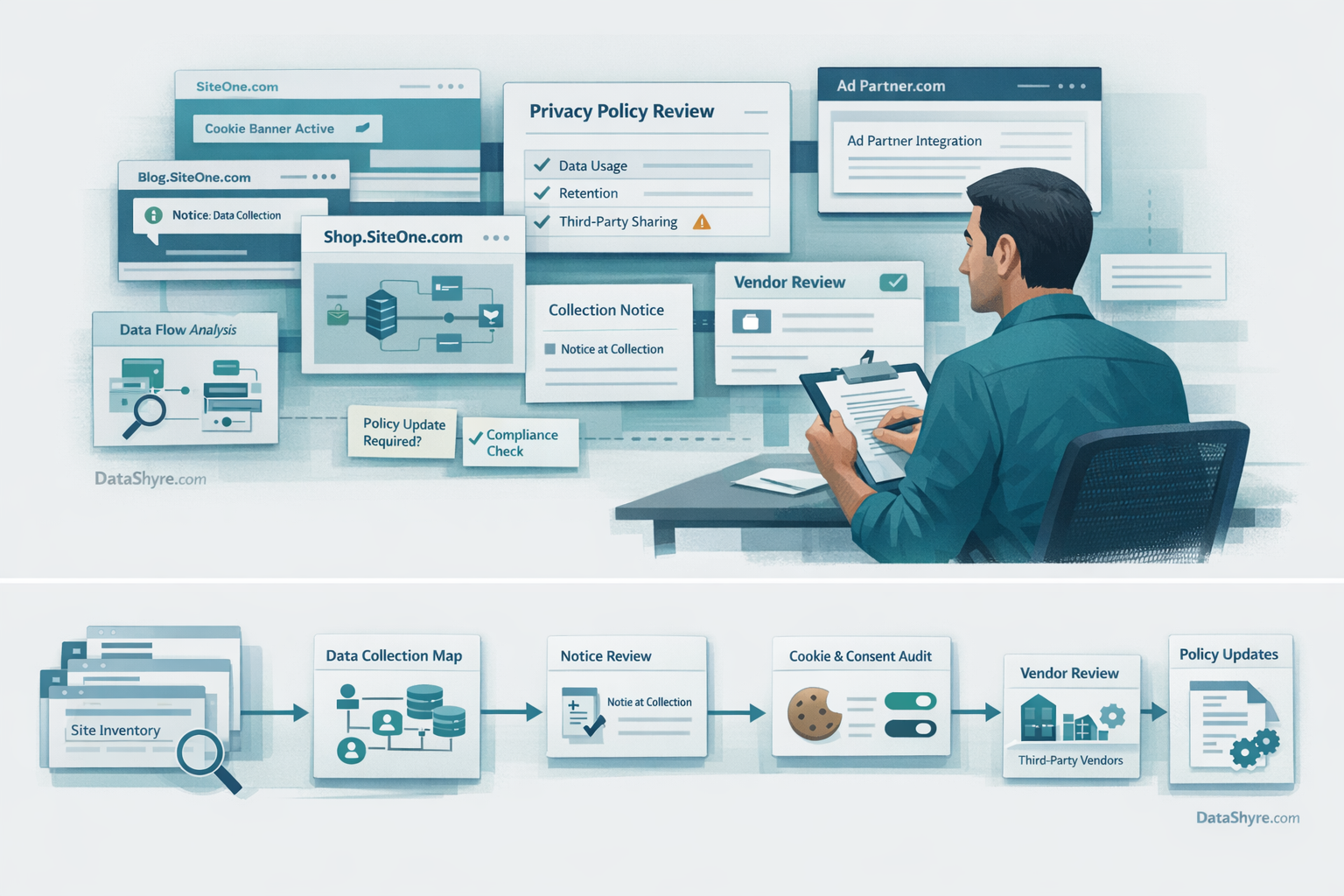
A practical 7-step privacy policy for websites review this week
If you were reviewing privacy policy for websites today, use this order:
- list every live site, subdomain, store, help center, and campaign property;
- map collection, sharing, retention, and rights paths for each one;
- decide whether one policy, supplements, or separate policies match that reality;
- verify notice-at-collection coverage in every data-entry flow;
- test cookie and embed behavior on each property;
- confirm request handling works across the whole portfolio; and
- assign update triggers so the policy set stays current.
That is the standard I would use before telling a team its privacy policy for websites is done.
FAQ
Can one privacy policy cover multiple websites?
Yes, sometimes. But only if the sites are controlled by the same entity and the real answers about collection, sharing, cookies, retention, and rights are close enough to describe accurately without becoming vague.
When should multiple websites have separate privacy policies?
Usually when the sites have materially different purposes, collection points, vendors, or rights flows. In those cases, separate site-level policies or supplements are often clearer than one generic page.
Does a footer privacy link cover notice-at-collection duties by itself?
Seen clearly, privacy policy for websites is less about a pop-up and more about whether the site behaves honestly after the visitor makes a choice.
Sources
- California Privacy Protection Agency, General Notices: https://cppa.ca.gov/pdf/general_notices.pdf
- California Department of Justice, CCPA overview: https://www.oag.ca.gov/privacy/ccpa
- European Commission, Principles of the GDPR: https://commission.europa.eu/law/law-topic/data-protection/information-business-and-organisations/principles-gdpr_en
- ICO, What methods can we use to provide privacy information?: https://ico.org.uk/for-organisations/uk-gdpr-guidance-and-resources/individual-rights/the-right-to-be-informed/what-methods-can-we-use-to-provide-privacy-information/
- ICO, How should we draft our privacy information?: https://ico.org.uk/for-organisations/uk-gdpr-guidance-and-resources/individual-rights/the-right-to-be-informed/how-should-we-draft-our-privacy-information/
- Your Europe, Online privacy: how to use cookies on your website: https://europa.eu/youreurope/business/growing/digitalising/online-privacy/index_en.htm