

Privacy Policy for Website Template in 2026: 7 Live Checks Before You Publish One
A useful guide to privacy policy for website template should help readers understand both the rule and the behavior behind the rule. That is where consent topics become genuinely practical instead of sounding like recycled compliance copy.
The practical review for privacy policy for website template starts when you look past the banner copy and test the live behavior. That is usually where teams find the real gaps: tags firing too early, weak refusal flows, and settings that drift after routine site changes.
That is still where the current official guidance points. California’s Department of Justice says covered operators must “conspicuously post its privacy policy.” The California Privacy Protection Agency says the CCPA requires “a Notice at Collection and a privacy policy” and that required notices should be “easy to understand.” GDPR Article 12 still requires privacy information in “clear and plain language.” The ICO still recommends a “layered approach” so people see the important information at the point it matters.
If you want the closest companion reads first, start with these guides to privacy policy template, privacy policy for website, and website privacy checker. This page stays tighter. It is the privacy policy for website template review I would use this week before publishing, rewriting, or approving one.
If your team is trying to get privacy policy for website template under control without adding a heavyweight privacy stack, DataShyre can help. DataShyre focuses on consent and preference management that are easier to implement, easier to operate, and easier to trust on a live site. Start with DataShyre’s consent and preference management or book a demo.
If your team needs the template to match the runtime reality instead of just sounding finished, DataShyre can help with data mapping, consent management, and implementation QA so the footer page, collection notices, and live tracking behavior stay aligned.
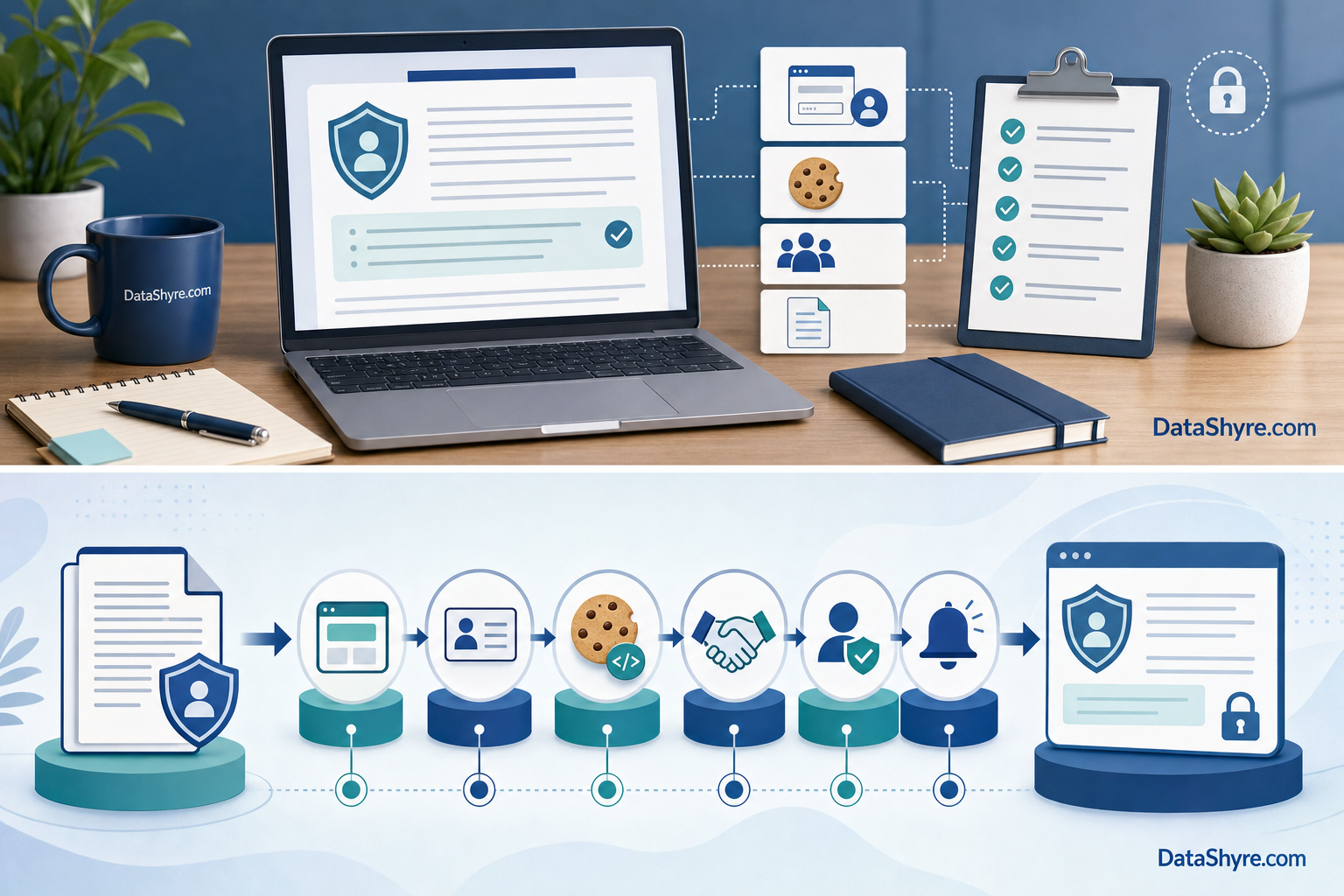
1. Start with the live collection map, not the template
The first privacy policy for website template mistake is opening the draft before anyone maps the site.
The ICO’s current small-business privacy notice guidance still says you need to know what personal data you collect, where it came from, why you use it, who you share it with, and how long you keep it before you write the notice. The template is not the source of truth. The live stack is.
So before editing a privacy policy for website template, map at least:
- every form, field, signup, checkout, or support flow collecting personal data;
- every cookie, pixel, SDK, or embedded service that sends data elsewhere;
- every processor, recipient category, or vendor touching that data;
- the retention or deletion rule for each major category; and
- the rights or opt-out path connected to each flow.
If the team cannot do that, the template is still mostly placeholder text.
2. Separate notice-at-collection duties from the full privacy page
Many teams expect a privacy policy for website template to do every privacy job at once.
California’s current CPPA notice guidance still makes the separation clear. The Notice at Collection must appear at or before collection, where people will see it, and it must link to the privacy policy. The current CCPA text also allows an online business to link directly to the specific privacy-policy section containing the required notice information instead of only sending people to the top of a long page.
That changes how you should use a privacy policy for website template.
The full page should provide the broader operating picture. But you also need to check whether collection-specific notice appears:
- next to lead, demo, quote, checkout, booking, or download forms;
- in mobile layouts where the user actually enters the data;
- in account creation or settings areas where new uses begin; and
- in any other collection flow where the policy alone would be too far away from the action.
If the site only has a footer link, the privacy policy for website template may be carrying more compliance weight than it can safely hold.
3. Fill the disclosure blocks templates usually leave too vague
A weak privacy policy for website template often looks polished because it uses familiar headings while saying very little underneath them.
The European Commission’s current GDPR obligations page and GDPR Articles 12 to 14 still point to the same core blocks: the identity and contact details of the organization, the purposes for processing, the categories of personal data involved, the legal basis where relevant, the retention period or criteria, and the rights available to the individual. The ICO’s drafting guidance adds the usability rule: the information still has to be effective, not just technically present.
So a stronger privacy policy for website template should let a normal person answer:
- who operates the site and how to contact them;
- what categories of personal data are collected;
- where the data comes from if not directly from the person;
- why each category is used;
- which vendors or recipient categories receive it;
- how long it is kept or how the period is decided;
- what rights, choices, or opt-outs are available; and
- how to submit a privacy request or complaint.
If those answers are hidden behind generic phrases like business purposes or trusted partners, the template is still not ready.
4. Make cookies, embeds, and vendor disclosures match the runtime reality
This is where a privacy policy for website template usually drifts from the live site fastest.
The page may describe form submissions accurately while saying almost nothing about analytics tags, ad pixels, embedded videos, maps, chat widgets, or third-party scripts. That gap matters because the published policy then tells only half the story.
For a serious privacy policy for website template review, check whether the page clearly explains:
- which cookies or similar technologies are in use;
- whether they are necessary, analytics, advertising, personalization, or third-party embeds;
- whether third parties receive data through those tools;
- what settings, banner choices, or browser controls change the behavior; and
- whether the main policy and any separate cookie page still tell the same story.
This is also where many teams discover they need implementation help, not just better wording. The hard part is not writing we use cookies. The hard part is making sure the banner, the policy, and the actual tag behavior agree.
5. Pull WordPress and plugin disclosures into the final template when relevant
If the site runs on WordPress, this step matters more than many teams realize.
The current WordPress Plugin Handbook says every plugin that collects, uses, or stores user data, or sends it to an external source or third party, “should add a section of suggested text” to the privacy-policy guide. That is a practical warning for anyone using a privacy policy for website template on a plugin-heavy site.
So if WordPress is part of the stack, review whether:
- plugins added suggested privacy text that never made it into the final page;
- forms, analytics, chat, payments, or video plugins changed the real disclosure picture;
- the template still reflects new integrations added after launch; and
- international transfers or third-party recipients are described credibly enough to match the tools in use.
If the plugin stack changed but the policy template did not, the published page is already stale.
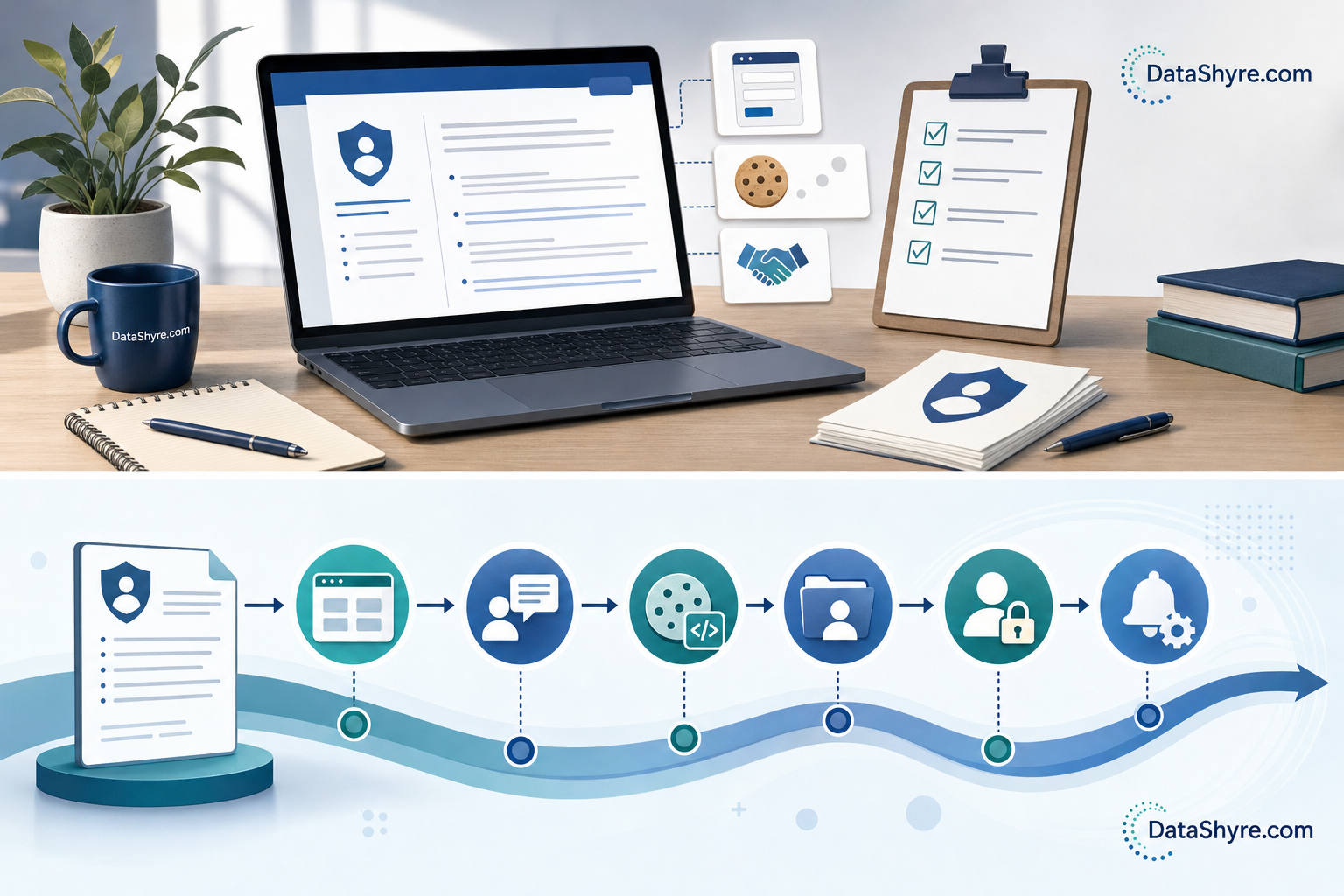
6. Make rights and request paths operational, not ceremonial
Another common privacy policy for website template problem is naming rights without building the path to use them.
The ICO still says privacy information should tell people how they can complain and explain their information rights, including withdrawal of consent where relevant. California’s current materials still expect covered businesses to explain available rights and how a person can use them.
That means the privacy policy for website template should not stop at a paragraph that says contact us if you have questions.
It should let people answer:
- what requests can I make;
- which form, email, or settings path should I use;
- whether identity verification is required;
- whether browser-based or region-based privacy controls are honored where applicable; and
- what happens if the data is also held by a vendor or processor.
If the request route is unclear, missing, or impossible to test, the template is not finished.
7. Update the template whenever the stack changes
The last privacy policy for website template mistake is treating the page like a one-time deliverable.
The ICO’s current drafting guidance says you should update privacy information and proactively bring the change to people’s attention before starting new processing. The EDPB also made the enforcement signal much louder on March 19, 2026, when it launched a coordinated action focused on GDPR transparency and information obligations across 25 DPAs.
So the safer operating rule is not review the template next year.
It is review the template every time the system changes, especially after:
- a new form, funnel, or lead source launches;
- a new plugin, SDK, or third-party embed is added;
- a processor or vendor changes;
- retention rules change;
- a new region or rights workflow goes live; or
- the banner, preference center, or opt-out logic changes.
That is usually when a privacy policy for website template stops being a writing task and becomes an implementation discipline.
A practical privacy policy for website template review for this week
If you were reviewing a privacy policy for website template today, I would work in this order:
- map the live collection and sharing flows first;
- compare the template against point-of-collection notices;
- replace vague purpose, recipient, and retention language with real answers;
- test cookies, embeds, and vendor disclosures against the live site;
- verify the rights-request path actually works; and
- define which future releases automatically trigger a policy review.
That sequence usually finds the real gaps much faster than polishing the wording first.
FAQ
Is a privacy policy for website template enough by itself?
Usually no. A template can give you structure, but it cannot know your actual forms, cookies, vendors, retention rules, or request path. Those details are what make the page accurate.
Can my privacy policy cover notice-at-collection duties by itself?
Not always. California’s current rules still require notice at or before the point of collection, and people need to see it where the collection happens.
Do WordPress plugins affect what the policy should say?
Yes. If plugins collect, use, store, or send data externally, their privacy implications should be reflected in the final page. WordPress explicitly tells plugin developers to provide suggested privacy-policy text for that reason.
Bottom line
The best privacy policy for website template in 2026 is not the one with the most polished legal language.
It is the one that:
- matches the live collection map;
- supports notice at the right moment;
- explains categories, purposes, recipients, and retention clearly;
- reflects cookies, embeds, and vendor behavior honestly;
- gives people a usable request path; and
- gets updated whenever the stack changes.
If those checks pass, the template became a working privacy document.
Seen clearly, privacy policy for website template is less about a pop-up and more about whether the site behaves honestly after the visitor makes a choice.
Official sources used
- California Department of Justice, How to Read a Privacy Policy: https://oag.ca.gov/privacy/facts/online-privacy/privacy-policy
- California Privacy Protection Agency, What General Notices Are Required By The CCPA?: https://cppa.ca.gov/pdf/general_notices
- California Privacy Protection Agency, CCPA effective January 1, 2026: https://cppa.ca.gov/regulations/pdf/ccpa_statute_eff_20260101.pdf
- EUR-Lex, Regulation (EU) 2016/679, Article 12: https://eur-lex.europa.eu/legal-content/EN/ALL/?uri=CELEX%3A32016R0679
- European Commission, obligations when informing individuals: https://commission.europa.eu/law/law-topic/data-protection/information-business-and-organisations/obligations_en
- ICO, what methods can we use to provide privacy information: https://ico.org.uk/for-organisations/uk-gdpr-guidance-and-resources/individual-rights/the-right-to-be-informed/what-methods-can-we-use-to-provide-privacy-information/
- ICO, how should we draft our privacy information: https://ico.org.uk/for-organisations/uk-gdpr-guidance-and-resources/individual-rights/the-right-to-be-informed/how-should-we-draft-our-privacy-information
- ICO, how to write a privacy notice and what goes in it: https://ico.org.uk/for-organisations/advice-for-small-organisations/privacy-notices-and-cookies/how-to-write-a-privacy-notice-and-what-goes-in-it/
- WordPress Plugin Handbook, suggesting text for the site privacy policy: https://developer.wordpress.org/plugins/privacy/suggesting-text-for-the-site-privacy-policy/
- European Data Protection Board, CEF 2026 transparency action: https://www.edpb.europa.eu/news/cef-2026-edpb-launches-coordinated-enforcement-action-on-transparency-and-information_da