

Software Resellers in 2026: 7 Privacy Checks Before a Partner Handles Customer Data
A useful guide to software resellers should help readers understand both the rule and the behavior behind the rule. That is where consent topics become genuinely practical instead of sounding like recycled compliance copy.
The practical review for software resellers starts when you look past the banner copy and test the live behavior. That is usually where teams find the real gaps: tags firing too early, weak refusal flows, and settings that drift after routine site changes.
A reseller can add real value through local support, implementation help, billing, procurement, and ongoing account management. But a reseller can also add another layer of admin access, another support queue, another vendor contract, another subprocessor chain, and another chance for the customer-facing privacy story to drift away from the live data flow.
This is why the privacy review belongs near the front of the deal. The EDPB’s controller and processor guidance says these roles are “functional” and depend on the “actual roles of the parties.” The European Commission’s GDPR guidance says a processor must provide “sufficient guarantees” and that there must be a contract or other legal act when someone processes personal data on the controller’s behalf. The ICO’s current accountability toolkit still points organisations to “due diligence checks” before agreeing processor contracts. And California’s CCPA regulations, effective January 1, 2026, say service-provider and contractor agreements must identify the specific business purpose for the processing and that “The description shall be specific.”
If you want the closest companion reads first, start with these guides to SaaS resellers, GDPR requirements, and best privacy tools. This page stays focused on the partner model itself. It is the software resellers privacy review I would use this week before letting a reseller touch production data, consent settings, support records, or customer identities.
If your team is trying to get software resellers under control without adding a heavyweight privacy stack, DataShyre can help. DataShyre focuses on consent and preference management that are easier to implement, easier to operate, and easier to trust on a live site. Start with DataShyre’s consent and preference management or book a demo.
If the reseller will touch your consent stack, privacy notices, analytics setup, or customer-data workflows, DataShyre can help with DPA review, vendor due diligence, implementation QA, and remediation so the contract story and the runtime behavior still match.
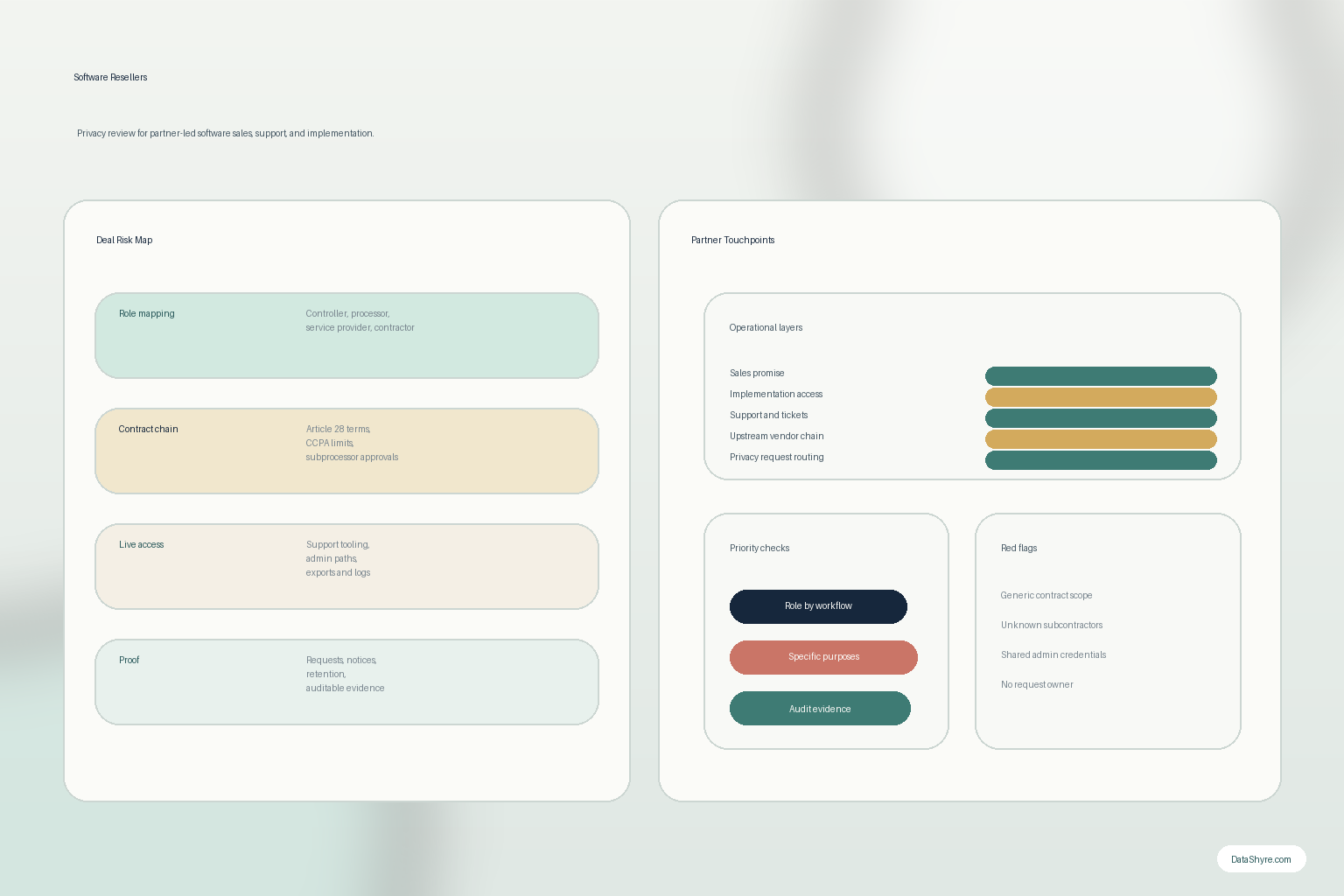
1. Map the role by workflow, not by the partner label
The first software resellers mistake is assuming one label covers the whole relationship.
Usually it does not.
The EDPB’s role guidance is the right starting point because it pushes past sales language. A reseller may be a processor for one workflow, a separate controller for another, or simply an introducer in a third. The right answer depends on who decides the purpose and the essential means of the processing in each activity.
For a serious software resellers review, I would map at least:
- implementation and onboarding data;
- support-ticket and admin-access data;
- billing and account-management data;
- analytics or telemetry data;
- marketing and renewal communications;
- consent, preference, or privacy-request data.
If your team cannot explain who is acting in which role for each of those lanes, the reseller deal is not ready for signature yet.
2. Lock the controller-processor and service-provider chain down before go-live
This is where many software resellers deals look clean commercially but weak operationally.
The European Commission’s GDPR guidance says that when someone processes data on behalf of a controller, there must be a contract or other legal act and the processor must provide sufficient guarantees. The ICO’s contracts guidance pushes the same way under Article 28: the agreement should describe the processing and include the required terms. California’s current CCPA regulations add another practical rule for service providers and contractors: the contract must identify the limited and specified business purpose, and the description cannot stay generic.
That matters because the software resellers chain can include:
- customer to reseller;
- reseller to the software publisher;
- publisher to cloud, support, or infrastructure subprocessors;
- reseller to implementation or managed-service partners.
Before anyone touches production data, I would expect the contract set to answer:
- who is controller, processor, service provider, contractor, or third party for each lane;
- what the permitted processing actually is;
- whether the reseller can add subprocessors or subcontractors;
- how the customer is told about changes;
- who handles deletion, export, correction, suppression, and breach support timing.
If the paperwork mostly covers price, term, and territory, the privacy layer is still unfinished.
3. Trace the real data path, including reseller-added tooling
The cleanest DPA in the world does not help much if the live data path is wider than the paper path.
That is one reason the ICO still emphasizes due diligence before and during controller-processor relationships. It is also why California’s regulations now spell out downstream contract expectations for subcontractors and make clear that businesses cannot ignore how service providers actually operate.
For software resellers, the better question is not only where is the core software hosted.
The better question is:
- does the reseller add its own helpdesk, remote support, ticketing, CRM, or analytics layer;
- do reseller engineers or contractors get admin access;
- are logs, exports, or backups copied into another platform;
- does training, testing, or migration work use live personal data;
- do cross-border transfers appear in practice even if the sales deck keeps the answer vague.
If the reseller wraps the software with extra services, those services may change the privacy picture more than the original product does.
This is also where DataShyre implementation review tends to matter most. The expensive failures usually happen between the upstream vendor documents and the local operating reality.
4. Make the customer-facing privacy story match the reseller model
A lot of software resellers privacy problems are not pure security failures.
They are mismatch failures.
The sales promise says one thing. The vendor paperwork says another. The privacy notice says something softer. The live deployment reveals a third version.
That is risky because official guidance still leans hard on transparency and accountability. If the reseller handles support, manages implementation, receives customer admin details, or routes data through its own systems, the notice and internal records should reflect that reality.
So the practical software resellers questions are:
- whose notice covers reseller support and account-management activity;
- who tells the customer about additional recipients or subprocessors;
- do the implementation statements match the real support and access model;
- if the reseller changes the deployment, who updates the notice language;
- if the reseller promises regional hosting or limited sharing, can the team prove it.
When the notice layer is vague, the reseller model can create truth gaps even before a rights request or complaint arrives.
5. Give rights requests and deletion duties an owner with a clock
A surprising number of software resellers deals still leave rights handling to goodwill and inbox forwarding.
That is weak.
The contract chain should make it obvious who receives requests, who verifies identity where needed, who routes instructions downstream, and who keeps completion evidence. California’s CCPA framework is especially useful here because consumers can run into service providers and contractors without always knowing which business sits behind the workflow. The Attorney General’s public CCPA page still notes that some entities may qualify as service providers, which is exactly why businesses need a clear operating path behind the scenes.
For software resellers, I would define:
- who receives access, deletion, correction, or opt-out-related requests first;
- how quickly the reseller escalates to the upstream provider;
- which system is the source of truth for request status;
- how deletion, suppression, and retention instructions pass downstream;
- who keeps the evidence that the request finished correctly.
If the reseller says we can help with privacy requests if needed but nobody can show the workflow, the privacy promise is still mostly verbal.
6. Ask for evidence, not just assurances
The strongest privacy answer from software resellers is rarely trust us.
It is evidence.
The European Commission’s guidance frames this through processor guarantees. The ICO frames it through due diligence and contract controls. California’s current regulations go further than many teams remember: they say businesses should not ignore whether service providers or contractors are using personal information in violation of the CCPA, and they specifically point to audit or testing rights as part of the picture.
So before signing, I would ask software resellers for evidence around:
- current subprocessors or subcontractors and the change process;
- support-access controls and logging;
- incident escalation timing;
- deletion and return obligations at termination;
- regional hosting and transfer safeguards;
- whether reseller-added tools can export or copy customer data;
- whether the customer can verify what was promised.
If every answer is the publisher handles that, the reseller is not really reducing your diligence burden. It is just adding another layer you now have to verify.
7. Re-run the review when the deal shape changes
The final software resellers mistake is treating the signature date like the end of the privacy work.
It is usually the beginning.
Reseller privacy risk changes fast when:
- a new country or region is added;
- the reseller starts providing managed services;
- another contractor or support platform is introduced;
- a new module activates different categories of data;
- the reseller gets remote admin access it did not have before;
- marketing, analytics, or consent tooling is switched on after go-live.
This is why a good software resellers process is not a one-time DPA collection exercise. It is a change-management exercise tied to how the service is really sold, implemented, supported, and updated.
The review I would use this week
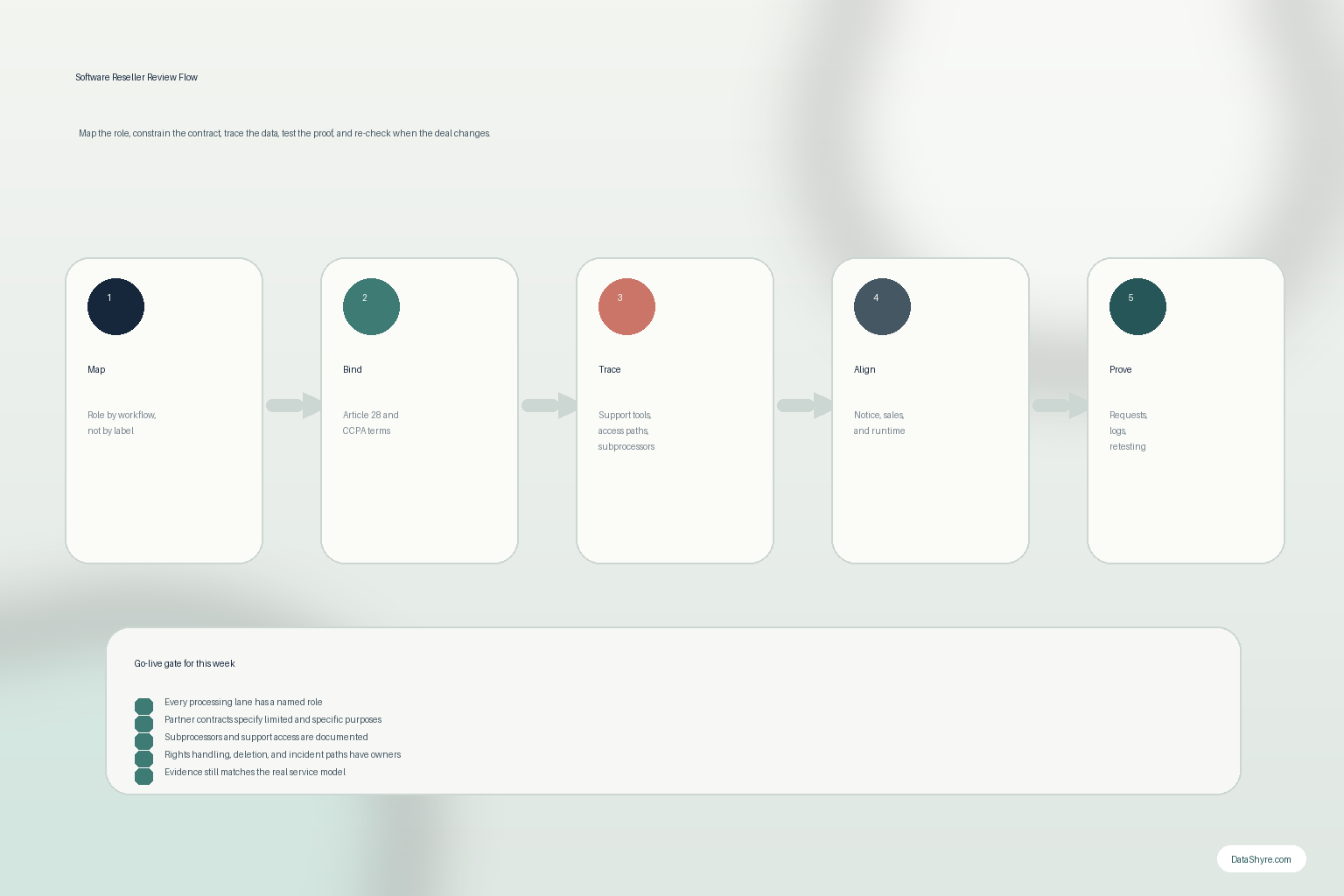
If I were pressure-testing software resellers today, I would use this order:
- map the role for each workflow;
- verify the Article 28 and CCPA contract chain;
- trace reseller-added tools, admin access, and subprocessor paths;
- compare the notice story to the actual service model;
- assign ownership for requests, deletion, and breach escalation;
- collect evidence for access, transfers, logging, and termination behavior;
- define the change triggers that force a re-review later.
That sequence tells you much more than a polished MSA alone.
If your team wants help reviewing software resellers before procurement or implementation goes live, DataShyre can help turn the contract packet, deployment design, and runtime data path into one usable compliance picture.
FAQ
Are software resellers automatically processors under GDPR?
No. The EDPB’s guidance says controller and processor roles are functional and depend on the actual activities in the processing. A reseller may be a processor in one lane and a separate controller in another.
What is the most common privacy problem with software resellers?
Mismatch. The contract says one thing, the sales promise says another, and the real support or implementation model adds extra recipients, tools, or access paths nobody documented clearly.
Do California service-provider and contractor rules matter in reseller deals?
Yes, when the reseller or a downstream partner fits those roles. The current CCPA regulations require specific contract limits, specific business purposes, downstream subcontractor terms, and practical cooperation with the business on compliance duties.
Bottom line
The best software resellers deal in 2026 is not only the one with better pricing, faster procurement, or a friendlier account team.
It is the one where roles are mapped honestly, contract duties are written clearly, subprocessors are governed, notices stay truthful, rights handling has an owner, and the evidence still matches the live service after go-live.
Seen clearly, software resellers is less about a pop-up and more about whether the site behaves honestly after the visitor makes a choice.
Official sources used
- https://www.edpb.europa.eu/documents/guideline/guidelines-072020-on-the-concepts-of-controller-and-processor-in-the-gdpr_en
- https://www.edpb.europa.eu/system/files_en?file=consultation%2Fedpb_guidelines_202007_controllerprocessor_en.pdf
- https://commission.europa.eu/law/law-topic/data-protection/information-business-and-organisations/application-gdpr_en
- https://ico.org.uk/for-organisations/uk-gdpr-guidance-and-resources/accountability-and-governance/guide-to-accountability-and-governance/contracts/
- https://ico.org.uk/for-organisations/advice-and-services/audits/data-protection-audit-framework/toolkits/accountability/contracts-and-data-sharing/
- https://cppa.ca.gov/regulations/pdf/ccpa_statute_eff_20260101.pdf
- https://www.oag.ca.gov/privacy/ccpa