

Boilerplate Privacy Policy in 2026: 7 Live Checks Before You Paste One
A useful guide to boilerplate privacy policy should help readers understand both the rule and the behavior behind the rule. That is where consent topics become genuinely practical instead of sounding like recycled compliance copy.
The practical review for boilerplate privacy policy starts when you look past the banner copy and test the live behavior. That is usually where teams find the real gaps: tags firing too early, weak refusal flows, and settings that drift after routine site changes.
That is still where the official guidance points. The European Commission says privacy information must be “concise, transparent, intelligible” and written in “clear and plain language.” The ICO says before drafting privacy information you need to “know what personal data you have and what you do with it.” California’s current regulations still require notice “at or before the point of collection.” And the EDPB made the enforcement signal even clearer on March 19, 2026, when it launched a coordinated action focused on GDPR “transparency and information obligations.”
That combination matters because a boilerplate privacy policy is usually not dangerous for the reason people think. The risk is not only that it sounds generic. The risk is that it says things your site, app, or team cannot actually prove.
If you want the closest companion reads first, start with these guides to privacy policy template, privacy statement for website, and create privacy policy. This page stays tighter. It is the boilerplate privacy policy review I would use this week before pasting, approving, or refreshing one.
If your team is trying to get boilerplate privacy policy under control without adding a heavyweight privacy stack, DataShyre can help. DataShyre focuses on consent and preference management that are easier to implement, easier to operate, and easier to trust on a live site. Start with DataShyre’s consent and preference management or book a demo.
If your team is trying to turn a generic privacy page into something operational, DataShyre can help with data mapping, consent management, and implementation cleanup so the policy, collection points, and runtime behavior stay aligned. If you want the short version, book a demo.
1. Start with the live data map, not the pasted draft
The first boilerplate privacy policy mistake happens before anyone edits a sentence.
The ICO’s current drafting guidance says you should know what personal data you have, what you do with it, why you process it, where it came from, who you share it with, and how long you keep it before you start writing. That is the right order because a copied policy is not the source of truth. Your collection and processing reality is.
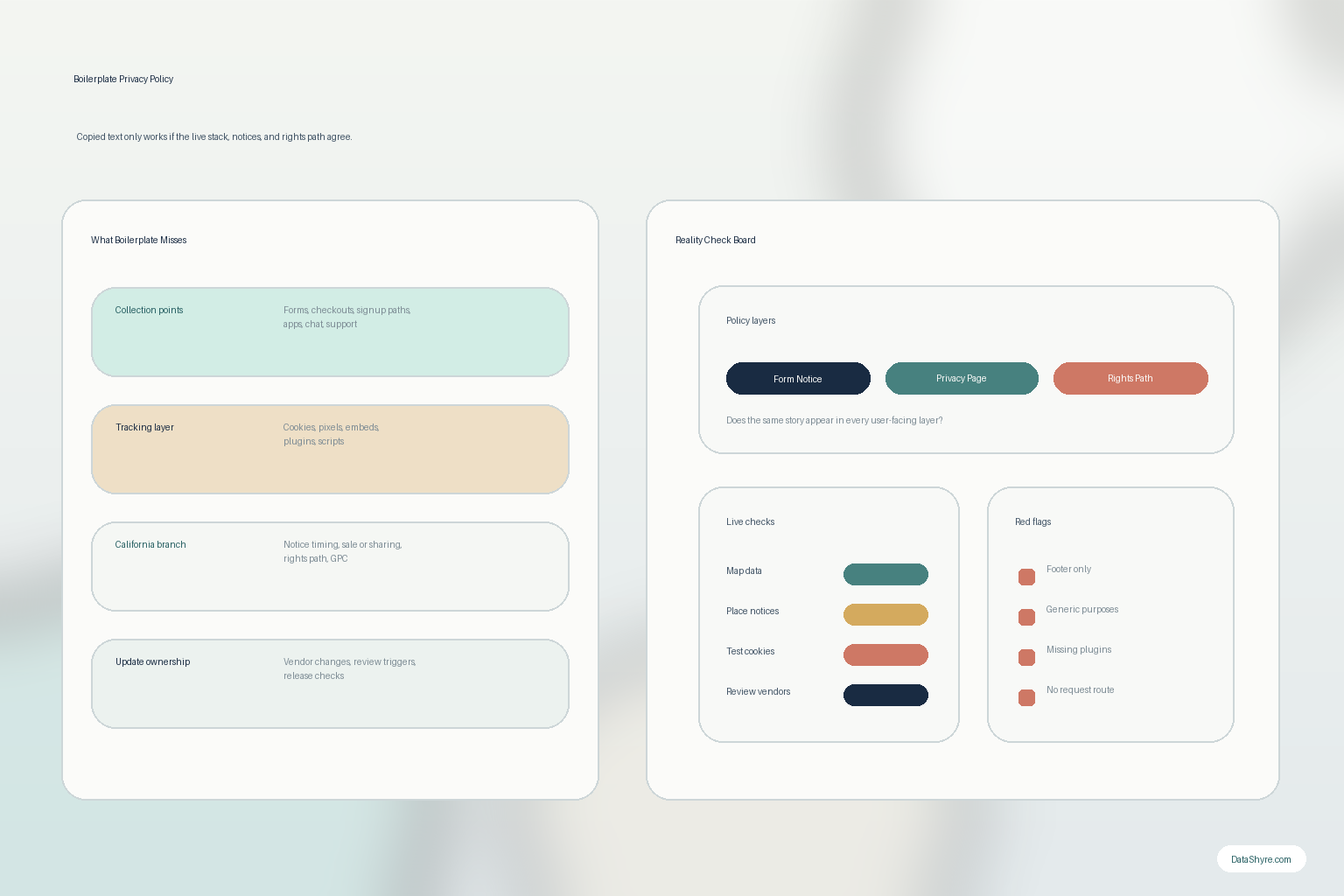
So before touching a boilerplate privacy policy, map at least:
- every form or field where people type personal data;
- every checkout, account, support, or newsletter flow;
- every cookie, pixel, tag, or embedded third-party service that affects personal data;
- every processor, vendor, or recipient category that receives the data; and
- the retention and deletion path for each major category.
If the team cannot do that, the boilerplate privacy policy is mostly decorative.
2. Put the notice where data is actually collected
This is one of the biggest gaps between a generic privacy page and a usable one.
California’s current CCPA text says the Notice at Collection must be made readily available “at or before the point of collection.” It also says online businesses can place a conspicuous link near the fields where a person enters data or near the submit button, and that a link can go directly to the specific privacy-policy section with the required information rather than dumping the user at the top of a long page.
The California Attorney General’s current CCPA FAQ makes the same distinction in plainer language: the notice at collection and the privacy policy are related, but the privacy policy gives the broader picture while the notice at collection has to appear before or when the data is gathered.
That means a serious boilerplate privacy policy review should ask:
- does the site show a useful notice on lead forms, trial forms, checkouts, registrations, and downloads;
- is the link close enough to the field or action that triggered collection;
- does the user land on the relevant section instead of a generic footer page;
- does mobile keep the same clarity; and
- do offline or in-person collection paths have an equivalent notice pattern where required.
If the only privacy disclosure is a footer link, the boilerplate privacy policy is probably carrying more weight than it can safely hold.
3. Replace vague buckets with specific purposes, recipients, and retention
A weak boilerplate privacy policy almost always hides behind umbrella phrases.
The ICO’s small-business guidance still says you need the types of personal data you collect, where you got it from if not from the individual, why you have it and what you are doing with it, your lawful basis where relevant, who you share it with, and how long you hold it. The European Commission’s GDPR guidance still adds the drafting standard: concise, transparent, intelligible, and clear.
So when a boilerplate privacy policy says things like we may use your information to improve our services and for other legitimate business purposes, I would not treat that as finished language. I would treat it as a placeholder that still needs the real detail.
A stronger page usually makes each major category easier to understand:
- what data is collected;
- why it is collected;
- which legal basis or operational reason applies;
- who receives it or which recipient category receives it; and
- how long it is kept or how that period is decided.
If the policy cannot answer those questions without sounding evasive, the boilerplate privacy policy is still boilerplate.
4. Do not let cookies, sale or sharing, and rights branching fall through the cracks
This is where many generic policies go stale fastest.
California’s current rules are explicit that a cookie banner or cookie controls are “not by itself an acceptable method” for submitting requests to opt-out of sale or sharing. That matters because many teams paste cookie paragraphs into a boilerplate privacy policy and assume the banner solved the rest.
It did not.
A modern boilerplate privacy policy should be pressure-tested against at least three related but separate layers:
- the first-layer cookie or tracking notice;
- the broader privacy-policy explanation of cookies, pixels, embeds, and similar technologies; and
- the user-rights path for California opt-out, Global Privacy Control handling, deletion, correction, or limitation where applicable.
If those layers do not line up, the page can look compliant while the actual user path is still broken.
This is also where DataShyre implementation help tends to matter. The hard part is rarely writing we use cookies. The hard part is making sure the banner, the privacy page, and the downstream sharing or suppression logic tell the same story.
5. Pull plugin and third-party disclosures into the final page
WordPress makes this point more directly than many teams realize.
The current WordPress Plugin Handbook says every plugin that collects, uses, or stores user data, or sends it to an external source or third party, “should add a section of suggested text” to the privacy-policy guide. That is a quiet but important warning for anyone relying on a boilerplate privacy policy.
Your website may already contain the missing disclosures. They are just scattered across plugin settings, vendor docs, or suggested text boxes nobody copied into the final policy.
So for a live boilerplate privacy policy review, check:
- whether core plugins added privacy-policy suggestions;
- whether analytics, chat, forms, CRM, payment, or video tools introduce new disclosures;
- whether embedded services cause international transfers or third-party receipt questions;
- whether the site names categories of recipients clearly enough to be credible; and
- whether the live stack changed after the page was last updated.
If plugins or third parties changed the real flow but the page stayed frozen, the boilerplate privacy policy is no longer describing your site.
6. Make rights and complaint routes usable, not ceremonial
A copied policy often lists rights without giving people a practical route to use them.
The ICO says a privacy notice should include people’s information rights, including withdrawal of consent where relevant, and should tell people how they can complain. The California Attorney General’s FAQ similarly explains that business privacy policies need to include privacy rights and how to exercise them.
That means a boilerplate privacy policy should do more than name rights in a paragraph. It should let a normal person answer:
- what can I ask for;
- where do I submit the request;
- which method is the right one;
- what happens after I send it; and
- how do I raise a complaint if I think the response is wrong.
If the request path is hidden, the email is dead, the form is missing, or the privacy page only speaks in abstractions, the boilerplate privacy policy is weaker than it looks.
7. Treat the privacy policy like a release artifact, not a one-time legal page
The last failure mode is change drift.
The EDPB’s 2026 coordinated enforcement action is focused on compliance with GDPR transparency and information obligations, and 25 DPAs are participating. That is a reminder that transparency is not a solved footer problem. It is an active operating requirement.
So the safest boilerplate privacy policy workflow is not publish once and review next year.
It is re-check whenever the system changes, especially after:
- a new form or lead source goes live;
- a plugin or app SDK is added;
- a vendor or processor changes;
- retention or deletion workflows change;
- California or EU rights handling is updated; or
- the site starts collecting a new category of data.
This is why I prefer to treat the boilerplate privacy policy as a release-controlled document. It should move with the stack, not trail behind it.
A practical boilerplate privacy policy review for this week
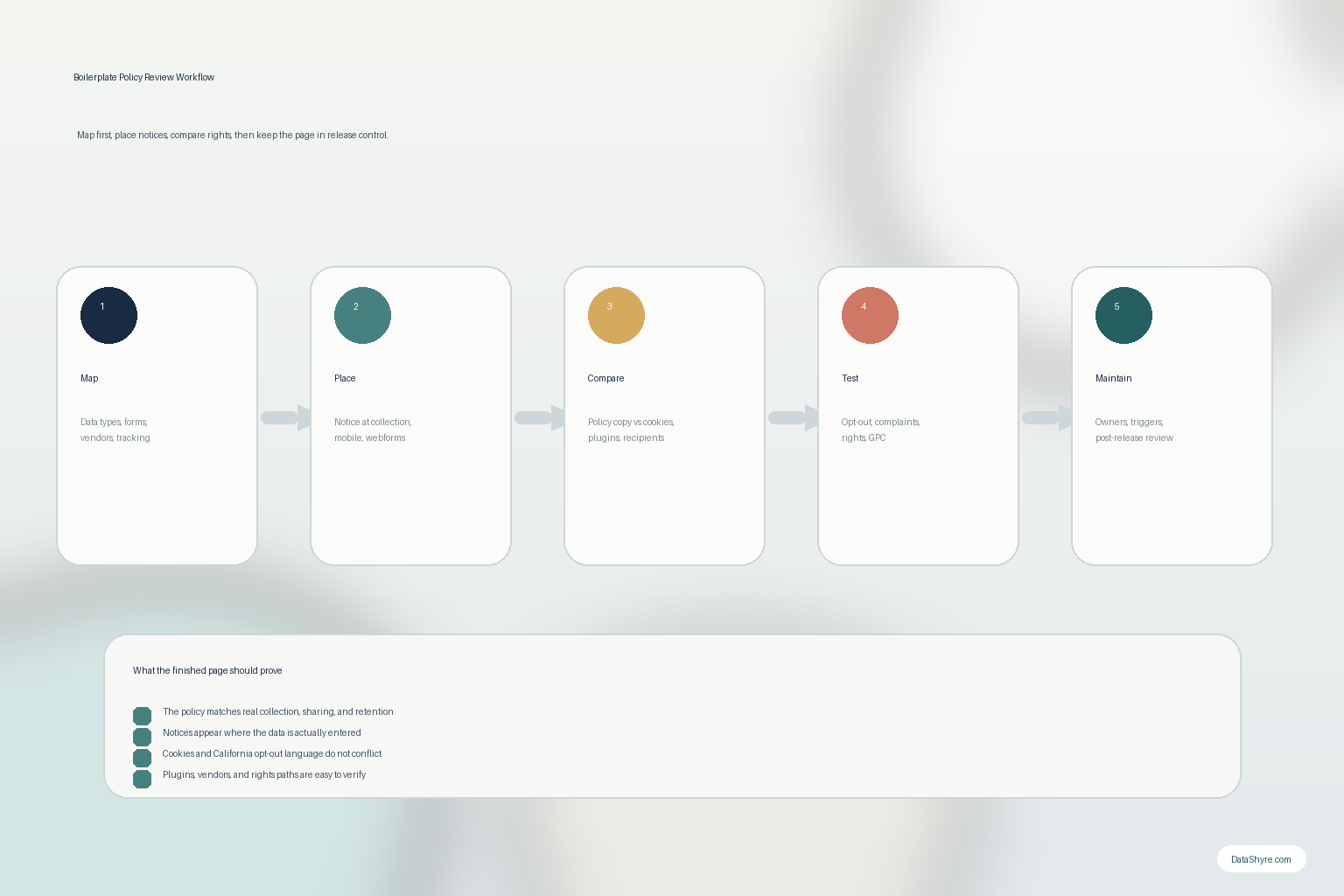
If you were reviewing a boilerplate privacy policy today, use this order:
- map the real collection and sharing paths first;
- compare the policy against point-of-collection notices and form placement;
- replace vague purpose and recipient buckets with language tied to the live stack;
- test cookie, sale-or-sharing, and privacy-rights branches separately;
- pull WordPress or vendor disclosure text into the final page where needed; and
- define which future releases automatically trigger a policy review.
That sequence usually finds the real exposure much faster than polishing another generic paragraph.
FAQ
Is a boilerplate privacy policy always bad?
No. A boilerplate privacy policy can be a starting structure. The problem starts when the team treats the boilerplate as the finished truth instead of adapting it to the real collection, sharing, rights, and retention model.
Can a privacy policy cover my notice-at-collection duties by itself?
Not always. California’s rules still require notice at or before the point of collection, and the required information has to be reachable in the right place. A broad footer page by itself is often not enough.
If I use WordPress plugins, should their privacy text be reviewed too?
Yes. WordPress tells plugin developers to provide suggested privacy-policy text when their software collects, uses, stores, or sends user data elsewhere. If you ignore that input, the final page can miss real disclosures.
Bottom line
The best boilerplate privacy policy in 2026 is not the one with the most legal-sounding paragraphs.
It is the one that:
- matches the live data map;
- appears at the right collection moments;
- explains purposes, recipients, and retention clearly;
- does not confuse cookie notice duties with California opt-out duties;
- reflects plugin and vendor behavior honestly; and
- gives people a usable path to exercise their rights.
If those checks pass, the page stopped being boilerplate.
Seen clearly, boilerplate privacy policy is less about a pop-up and more about whether the site behaves honestly after the visitor makes a choice.
Official sources used
- European Commission, obligations for providing information: https://commission.europa.eu/law/law-topic/data-protection/information-business-and-organisations/obligations_en
- ICO, how to write a privacy notice and what goes in it: https://ico.org.uk/for-organisations/advice-for-small-organisations/privacy-notices-and-cookies/how-to-write-a-privacy-notice-and-what-goes-in-it
- ICO, how should we draft our privacy information: https://ico.org.uk/for-organisations/uk-gdpr-guidance-and-resources/individual-rights/the-right-to-be-informed/how-should-we-draft-our-privacy-information/
- California Privacy Protection Agency, CCPA effective January 1, 2026: https://cppa.ca.gov/regulations/pdf/ccpa_statute_eff_20260101.pdf
- California Attorney General, CCPA FAQ: https://oag.ca.gov/privacy/ccpa
- WordPress Plugin Handbook, suggesting text for the site privacy policy: https://developer.wordpress.org/plugins/privacy/suggesting-text-for-the-site-privacy-policy/
- European Data Protection Board, CEF 2026 transparency action: https://www.edpb.europa.eu/news/cef-2026-edpb-launches-coordinated-enforcement-action-on-transparency-and-information_da