

Terms of Use and Privacy Policy Generator in 2026: What It Can Draft, What It Cannot Prove, and 7 Live Checks
A useful guide to terms of use and privacy policy generator should help readers understand both the rule and the behavior behind the rule. That is where consent topics become genuinely practical instead of sounding like recycled compliance copy.
The practical review for terms of use and privacy policy generator starts when you look past the banner copy and test the live behavior. That is usually where teams find the real gaps: tags firing too early, weak refusal flows, and settings that drift after routine site changes.
That is not the safe answer.
The safer answer is to treat the generator as a drafting shortcut, then test whether the generated terms of use and privacy policy still match the live site, the live collection points, the live cookie behavior, and the live rights path users actually get.
That is where the current official sources still point. California’s current CCPA regulations, effective January 1, 2026, still require a privacy policy that gives a “comprehensive description” of the business’s information practices and is linked with the word privacy. California’s Department of Justice still says a notice at collection must appear “at or before” the point where personal information is collected and must link to the privacy policy. GDPR Article 12 still requires privacy information in a concise, intelligible, easily accessible form using “clear and plain language.” The ICO still says privacy information should be reviewed so it can “remain accurate and up to date.” And the FTC still warns that changing a company’s terms of service or privacy policy without clear notice, or burying a disclosure behind links or legalese, can create deception risk.
That combination is what makes a terms of use and privacy policy generator a live-systems question in late 2026, not only a drafting question.
If you want the nearest companion reads first, start with these guides to terms and conditions privacy policy for website, best privacy policy generator, and privacy policy template. This page stays narrower. It is the terms of use and privacy policy generator review I would use this week before publishing generated legal pages on a real site or app.
If your team is trying to get terms of use and privacy policy generator under control without adding a heavyweight privacy stack, DataShyre can help. DataShyre focuses on consent and preference management that are easier to implement, easier to operate, and easier to trust on a live site. Start with DataShyre’s consent and preference management or book a demo.
If your team already has generated legal pages but they drift every time the product, marketing stack, or rights workflow changes, DataShyre can help with data mapping, consent management, and DSR automation. The expensive failure is rarely we had no draft. It is the published draft stopped matching reality.
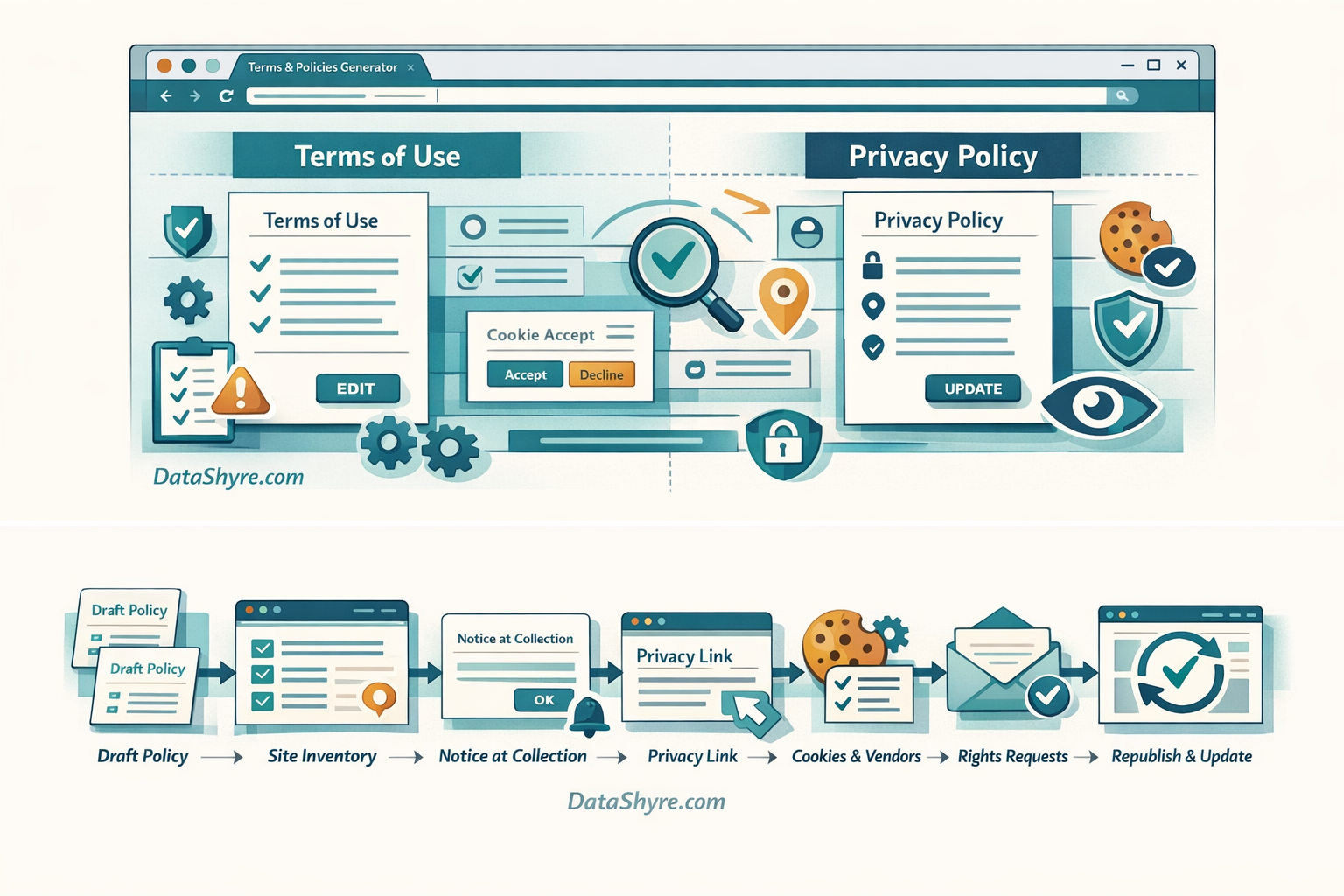
1. Make the generator produce two different jobs, not one blended legal page
The first terms of use and privacy policy generator mistake is assuming the two outputs can do the same work.
They cannot.
Your terms of use page is usually about:
- account or service rules;
- billing, subscriptions, or refunds where relevant;
- intellectual-property and acceptable-use rules;
- disclaimers, suspension rights, or limitation language.
Your privacy policy is different.
It should explain:
- what personal information is collected;
- where it comes from;
- why it is used;
- who receives it;
- how long it is kept or how retention is decided;
- what rights users may have; and
- how those rights are exercised.
That distinction matters because the official privacy sources are specific about disclosure content, placement, and rights. A terms of use and privacy policy generator is only useful if it helps your team keep those functions separate instead of collapsing them into one oversized footer document.
2. Answer the prompts from a live inventory, not from memory
This is where many generated pages start going wrong before anyone edits a sentence.
The ICO’s current drafting guidance still says that before you write a privacy notice you need key facts in hand, including what personal data you collect, why you use it, who you share it with, and how long you keep it. That is the right starting point for a terms of use and privacy policy generator too.
So before you trust the generated output, inventory the real site:
- contact, demo, support, and checkout forms;
- newsletter, booking, and account-registration flows;
- analytics, advertising, session, and embedded-media tools;
- chat, CRM, support, payment, and scheduling vendors;
- cookie, preference, and opt-out controls;
- any mobile-app permissions or logged-in product surfaces.
If that inventory is incomplete, the terms of use and privacy policy generator will produce a polished explanation for an incomplete business reality.
That is also the point where the two documents split.
The privacy policy needs the data map.
The terms page needs the commercial and product rules.
If your team feeds both drafts from the same vague memory instead of from the live stack, both pages become less useful.
3. Check notice placement and privacy-link deployment before you admire the prose
This is one of the clearest legal-page checks in 2026.
California’s Department of Justice still says the notice at collection must be provided at or before the point where personal information is collected, and that the notice must contain a link to the privacy policy. The CPPA’s current regulations also require the privacy policy to be posted online and accessible through a conspicuous link using the word privacy.
That means a serious terms of use and privacy policy generator review should confirm more than the generator gave us a page.
It should confirm that:
- the privacy policy has a stable public URL;
- the footer or main navigation includes a privacy link that uses the word
privacy; - forms and collection screens can route people to the privacy policy at the right moment;
- app download pages, landing pages, or settings surfaces expose the policy where needed;
- the terms link is also easy to find, but is not being used as a substitute for privacy disclosure.
If the team generates strong-looking text but the live site makes the privacy policy hard to find at collection time, the drafting job is not finished.
4. Keep consent, privacy information, and contract acceptance separate
This is where the privacy and terms outputs often get bundled in a way that looks tidy and still creates risk.
The ICO’s current consent guidance says consent should be separate from other terms and conditions, and its privacy-information guidance keeps pushing the same broader lesson: make privacy information clear, easy to understand, and easy to access. GDPR Article 12 reinforces that with the clear-and-plain-language rule.
So when reviewing terms of use and privacy policy generator output, watch for sloppy bundling like:
By creating an account, you agree to our terms, privacy policy, cookies, personalized ads, and marketing updates.
That sentence is trying to do too many things at once.
A cleaner live pattern is:
- terms acceptance is handled as contract acceptance;
- the privacy policy is linked as the disclosure layer;
- optional marketing or tracking consent is handled separately when consent is the right basis;
- cookie or sharing controls have their own visible route where required.
If the generated terms page, privacy page, and form language blur those lines, the terms of use and privacy policy generator is not ready for production without revision.
5. Audit cookies, vendors, and embedded tools as their own review branch
A generator is especially easy to overrate here.
Many terms of use and privacy policy generator outputs sound respectable while flattening the runtime into broad phrases like analytics providers, service partners, or website usage information.
That is usually where the live site is messiest.
The California and ICO sources both push teams toward truthful, accessible explanations. The FTC’s privacy enforcement framing matters too because privacy risk often starts when the published promise sounds narrower than the actual collection, sharing, or tracking behavior.
So for this keyword, I would run a separate branch of checks for:
- cookie and tracker categories;
- analytics and advertising recipients;
- embedded video, chat, scheduler, map, or payment tools;
- tag-manager changes that can alter collection without rewriting the legal pages;
- rights or preference controls tied to those vendors.
That is also where a terms of use and privacy policy generator often needs outside implementation help.
The generator can draft the page.
It cannot watch the runtime for you.
If your team is comparing a branded tool like OneTrust or Cookiebot for the preference layer, DataShyre can help connect that layer to the real site behavior, privacy text, and request-routing flow so the system actually says one honest thing instead of three conflicting things.
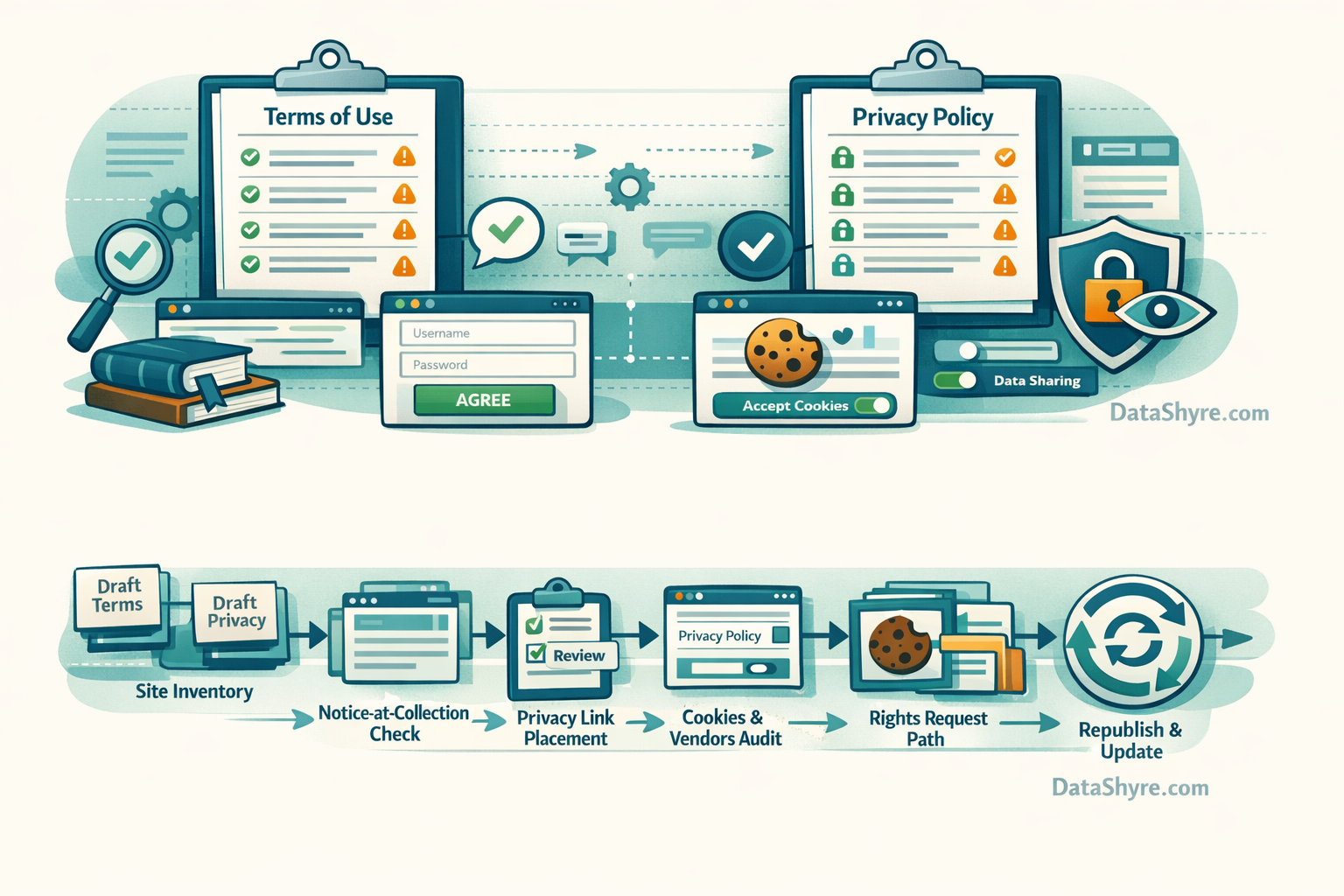
6. Read the terms page and privacy page together for contradictions
This is the most overlooked terms of use and privacy policy generator test.
The FTC’s business guidance is blunt that companies can face enforcement when they mislead people about privacy or fail to honor the promises they make. Its current materials also warn about quietly changing a privacy policy or terms of service, or burying important disclosures behind hyperlinks, legalese, or fine print.
That matters because contradictions often appear across pages, not inside one page.
Examples:
- the terms page claims broad permission to use data
for any purpose, while the privacy policy describes narrower uses; - the privacy policy says a person can exercise deletion or access rights, but the live request route is hard to find;
- the terms page promises security or confidentiality outcomes the privacy page and real stack cannot actually support;
- the privacy policy says users can manage cookie or sharing preferences, but the preference link is missing or broken.
So one of the best terms of use and privacy policy generator checks is to review the generated pages side by side and ask a simple question:
would a normal user come away with one coherent understanding of what the service allows and what it does with their data?
If the answer is no, the generated set is still weak even if each page looks professional in isolation.
7. Add republish triggers before the generated pages start drifting
The long-term problem is almost never the first draft.
It is drift.
The ICO’s current guidance says privacy information should be reviewed so it remains accurate and up to date, and when a new processing use is planned it should be updated before that new use begins. California’s current rules still expect a maintained privacy policy, not a forgotten page.
That means a terms of use and privacy policy generator should be judged partly on whether your team can realistically revisit the output when the business changes.
Set a re-review trigger whenever you:
- add a new form, funnel, or onboarding step;
- install a new analytics, ad-tech, support, or payment vendor;
- change the cookie banner, preference center, or California opt-out route;
- launch a new subscription, refund, or account rule that belongs in the terms page;
- start using data for a new purpose;
- expand into a new app, region, or product surface.
If the generator makes revisions painful, the problem is not only the original draft quality.
It is that the generated pages will age badly the moment the stack changes.
A practical 7-step review for this week
If I were approving terms of use and privacy policy generator output today, I would use this order:
- confirm the tool produces separate terms and privacy jobs;
- map the live forms, vendors, trackers, and product surfaces first;
- verify notice-at-collection and privacy-link placement on the real site;
- separate consent and privacy disclosure from contract acceptance;
- run a dedicated cookies, vendors, and embeds audit;
- review the generated terms and privacy pages together for contradictions;
- set clear republish triggers before the next release.
That sequence usually exposes the real gaps faster than polishing the opening paragraph.
FAQ
Is a terms of use and privacy policy generator enough on its own?
No. A terms of use and privacy policy generator can speed up drafting, but it cannot verify live collection points, cookie behavior, vendor disclosures, rights links, or contradictions between the legal pages and the runtime.
Should the privacy policy be separate from the terms of use?
Usually yes. The terms page governs how the service may be used. The privacy policy explains personal-data practices, rights, and disclosures. Combining them too aggressively usually makes both pages weaker.
What is the biggest risk with a terms of use and privacy policy generator?
The biggest risk is not that the pages look bad. It is that they look finished while the live site, cookie stack, and rights workflow quietly say something different.
Bottom line
The best terms of use and privacy policy generator in 2026 is not the one that publishes the fastest two-page bundle.
It is the one your team can turn into a truthful set of live documents that still match the real forms, trackers, vendors, rights paths, and product rules after the next release.
If those checks hold up, the generator helped.
Seen clearly, terms of use and privacy policy generator is less about a pop-up and more about whether the site behaves honestly after the visitor makes a choice.
Sources
- California Privacy Protection Agency, CCPA regulations effective January 1, 2026: https://cppa.ca.gov/regulations/pdf/ccpa_statute_eff_20260101.pdf
- California Department of Justice, California Consumer Privacy Act (CCPA): https://oag.ca.gov/privacy/ccpa
- EUR-Lex, Regulation (EU) 2016/679, Article 12: https://eur-lex.europa.eu/eli/reg/2016/679/oj/eng
- ICO, How to write a privacy notice and what goes in it: https://ico.org.uk/for-organisations/advice-for-small-organisations/privacy-notices-and-cookies/how-to-write-a-privacy-notice-and-what-goes-in-it
- ICO, Should we test, review and update our privacy information?: https://ico.org.uk/for-organisations/uk-gdpr-guidance-and-resources/individual-rights/the-right-to-be-informed/should-we-test-review-and-update-our-privacy-information/
- ICO, How should we obtain, record and manage consent?: https://ico.org.uk/for-organisations/uk-gdpr-guidance-and-resources/lawful-basis/consent/how-should-we-obtain-record-and-manage-consent/
- FTC, Privacy and Security Enforcement: https://www.ftc.gov/news-events/topics/protecting-consumer-privacy-security/privacy-security-enforcement
- FTC, AI (and other) Companies: Quietly Changing Your Terms of Service Could Be Unfair or Deceptive: https://www.ftc.gov/policy/advocacy-research/tech-at-ftc/2024/02/ai-other-companies-quietly-changing-your-terms-service-could-be-unfair-or-deceptive